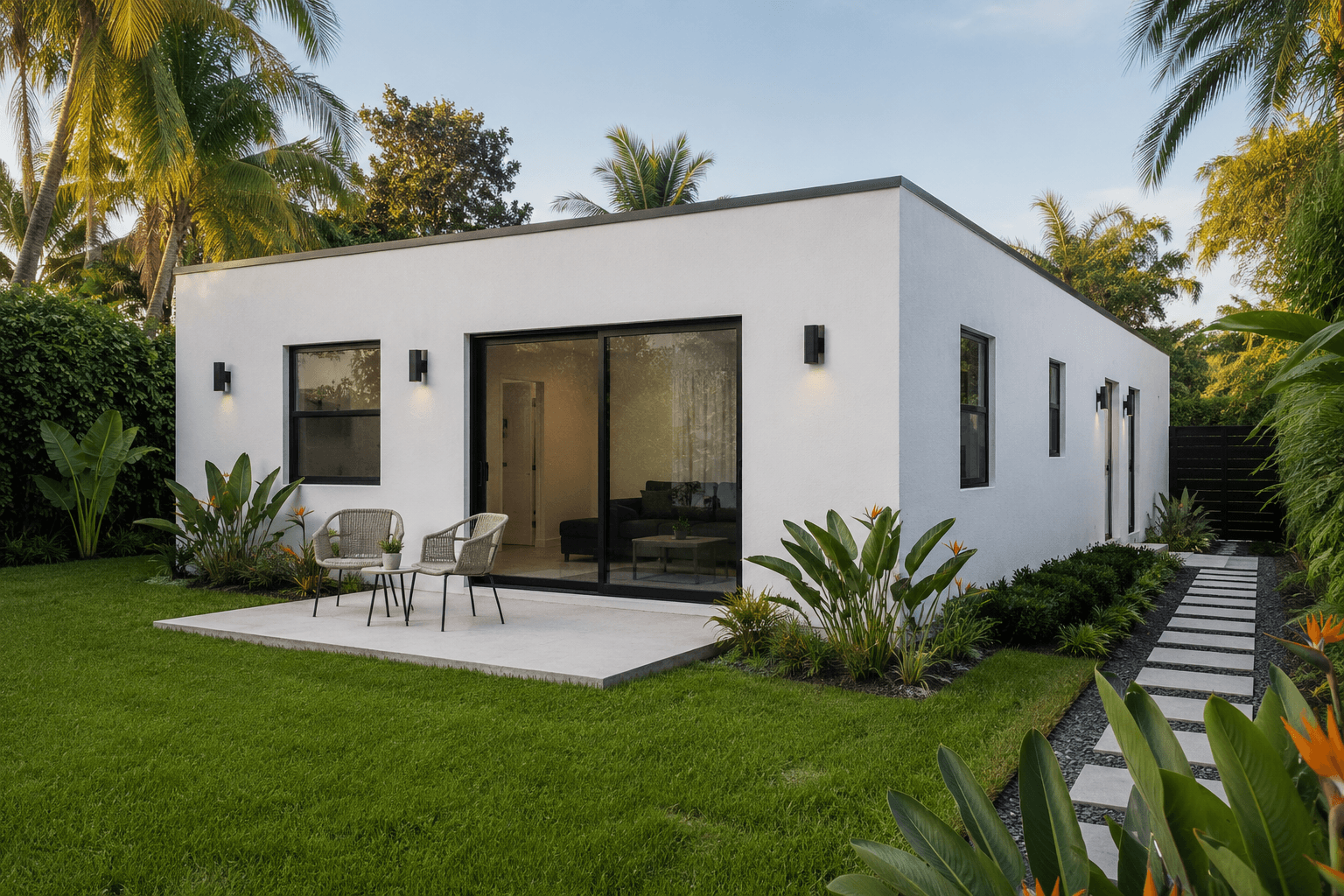
How to Build an ADU in Miami
2026 Complete Guide
Everything Miami homeowners need to know: HVHZ wind requirements, five-jurisdiction breakdown, Certificate of Use, costs ($180K–$350K), permits, and ROI.
Miami's housing market is one of the most expensive in the country — and that reality has made ADUs (accessory dwelling units) one of the most compelling investments a Miami homeowner can make. A well-built ADU in the right Miami neighborhood can generate $2,000–$3,500/month in rental income while adding $200,000 or more to your property value.
But Miami is also one of Florida's most complex ADU markets. Miami-Dade County sits entirely within the HVHZ wind requirements zone — the most stringent hurricane construction standard in the United States — and the metro area spans five distinct jurisdictions, each with its own code and permit process. In Miami-Dade County, getting this wrong is expensive.
This guide covers everything: Miami ADU rules, the five-jurisdiction breakdown, HVHZ requirements, the Certificate of Use process, what it costs ($180K–$350K), the full permit process step by step, financing options, and realistic ROI figures for Miami's rental market.
Empecemos con la pregunta más importante: ¿Puede construir en su propiedad específica? Let's start with the most important question: can you build on your specific property?
Free · Takes 2 Minutes · Gratis
Find Out What You Can Build — Free Zoning Check
Enter your address and we'll tell you your zoning transect, which Miami jurisdiction applies, whether ADUs are permitted, and what size you can build. / Ingrese su dirección y le diremos su zona, qué jurisdicción aplica, y qué puede construir.
Check My Property / Verificar Mi PropiedadSection 1
Miami ADU Laws & Zoning — What You Need to Know in 2026
Miami has one of Florida's most opportunity-rich — and most complex — ADU environments. Understanding which of the five jurisdictions governs your property is the single most important thing you can do before investing a dollar.
Florida State Law: The 2026 Backdrop
Florida Statute §163.31771 lets local governments adopt ordinances permitting ADUs, but it does not require every jurisdiction to allow them and creates no statewide right to build. Whether ADUs are permitted in a given Miami-Dade municipality — and under what conditions — depends on that jurisdiction's own ordinance, so confirm the rules for your city before relying on them. See our full breakdown of Florida ADU laws for the complete picture.
City of Miami ADU Rules (Miami 21 Code)
The City of Miami uses the Miami 21 transect-based zoning code. ADUs are permitted in T3 (single-family suburban) and T4 (general urban) transect zones. For a quick reference, see our Miami ADU rules page. Key rules include:
- Eligible transect zones: T3-O (open), T3-L (limited), T3-R (restricted), T4-O (open), T4-L (limited) — verify your specific parcel's transect zone via the Miami GIS portal.
- Size limit: Detached ADUs limited to the smaller of 750 sq ft or 50% of the principal dwelling's living area in T3 zones.
- Setbacks: Rear and side setbacks per your transect zone standards — typically 5–7.5 ft depending on lot size and zone.
- Design standards: Miami 21 has specific urban design standards including facade articulation requirements. Exterior design must be compatible with the primary structure's architectural style.
- Certificate of Use: Required before legally renting any non-owner-occupied unit in the City of Miami — including ADUs. Must be renewed annually.
- HVHZ compliance: All ADU construction in Miami-Dade County must meet High-Velocity Hurricane Zone (HVHZ) structural and envelope requirements — impact glass, enhanced structural connections, HVHZ-rated roofing.
The HVHZ Requirement — What It Means for Your Budget
⚠️ HVHZ: The Most Important Miami-Specific Factor
Miami-Dade and Broward counties are designated High-Velocity Hurricane Zones (HVHZ) — the highest wind load category in the Florida Building Code. HVHZ requires impact-resistant windows and doors (rated to 175 mph+), HVHZ-rated roofing systems, and enhanced structural connections that exceed non-HVHZ standards. Budget $20,000–$40,000 more than a comparable Central Florida ADU project. This is mandatory and cannot be waived.
Miami 21 Transect Zone Standards — ADU-Eligible Districts
Miami 21 replaces conventional zoning with a transect-based system. ADUs (called "backyard units" in some Miami 21 references) are allowed in T3 and T4 transect zones. Below are the key development standards by transect.
| Transect | Intent | Min Lot | Front Setback | Side Setback | Rear Setback | Max Height |
|---|---|---|---|---|---|---|
| T3-R | Restricted single-family | 5,000 sf | 20 ft | 5 ft | 20 ft | 2 stories |
| T3-L | Limited single-family | 5,000 sf | 20 ft | 5 ft | 20 ft | 2 stories |
| T3-O | Open single-family | 5,000 sf | 10 ft | 5 ft | 20 ft | 2 stories |
| T4-R | Restricted general urban | 5,000 sf | 10 ft | 0–5 ft | 20 ft | 3 stories |
| T4-L | Limited general urban | 5,000 sf | 10 ft | 0–5 ft | 20 ft | 3 stories |
| T4-O | Open general urban | 5,000 sf | 10 ft | 0–5 ft | 20 ft | 3 stories |
ADU size cap: 750 sq ft or 50% of primary dwelling, whichever is less. Miami Beach and Coral Gables maintain separate transect-equivalent codes with stricter design review — verify your municipality before applying Miami 21 standards above.
HOA Considerations
⚠️ Miami's HOA Landscape Is Dense
A very high percentage of Miami-area properties are in HOA or condo association-governed communities. HOA covenants are private contracts enforceable regardless of what zoning allows. Review your CC&Rs — in both English and Spanish if applicable — with an HOA attorney before investing in design or permits.
Section 2
Types of ADUs You Can Build in Miami
Miami's dense urban and suburban fabric shapes which ADU types are practical. Detached ADUs are common in South Miami, Coconut Grove, and parts of unincorporated Miami-Dade. Here's the full breakdown.
| ADU Type | Typical Cost Range (Miami) | Timeline | Best For |
|---|---|---|---|
| Detached ADU — Standalone backyard cottage/casita | $180K–$350K+ | 12–20 months | Rental income, multigenerational, privacy |
| Attached ADU — Addition connected to main home | $140K–$250K | 9–16 months | Family use, shared utilities, smaller lots |
| Garage Conversion — Converting existing garage | $80K–$160K | 5–10 months | Lowest-cost path; HVHZ envelope upgrade required |
| Interior Conversion — Large interior space | $70K–$140K | 4–9 months | Homes with large bonus rooms or underutilized space |
| Modular / Prefab ADU — HVHZ-certified, factory-built | $150K–$220K installed | 12–28 weeks from order | Speed + predictable costs on accessible lots |
Miami Note: HVHZ Applies to All ADU Types
Unlike other Florida markets, every ADU type in Miami — including garage conversions and interior conversions — requires HVHZ-compliant envelope upgrades: impact windows, impact doors, and HVHZ-rated roofing. Even a garage conversion requires replacing all windows and the garage door with HVHZ-rated impact products if these don't already exist. Factor this into your budget for every ADU type.
Section 3
Miami's Five-Jurisdiction Breakdown — Which Rules Apply to You?
“Miami” is not one jurisdiction. The Miami metro contains over 30 municipalities, each with its own code and building department. Here are the five you're most likely to encounter as an ADU-seeking homeowner.
City of Miami
Miami 21 CodeUses the Miami 21 transect-based zoning code. ADUs permitted in T3 and T4 transect zones. Certificate of Use required before renting. Permit applications submitted through the City of Miami Building Department portal. HVHZ requirements apply to all construction.
Miami ADU Rules →Miami-Dade County (Unincorporated)
County CodeUnincorporated areas of Miami-Dade County (outside any city limits) follow Miami-Dade County's Zoning Code. ADUs permitted in RU-1 and other single-family zones. Permits through Miami-Dade's iBuild online permitting system. HVHZ requirements apply. Different size and setback standards than City of Miami.
Miami-Dade County Rules →Miami Beach
Strict Design ReviewIndependent city with its own comprehensive plan and zoning code. Significant portions of Miami Beach are in historic districts governed by the Historic Preservation Board — ADU design approval can add months to the process. HVHZ requirements apply. See our Miami Beach ADU rules page for specifics.
Miami Beach ADU Rules →Coral Gables
Historically RestrictiveCoral Gables maintains its own city charter with historically strict design and construction standards. ADU approvals require compliance with Coral Gables' specific architectural standards and may involve the City Beautiful Commission review process. Highest costs and longest timelines of the five jurisdictions. See our Coral Gables ADU rules page.
Coral Gables ADU Rules →Hialeah
More PermissiveHialeah has its own code and is generally more permissive than the City of Miami or Coral Gables for ADU approvals. Predominantly single-family residential areas in eligible zones may permit ADUs by right under the city ordinance — confirm with Hialeah. HVHZ requirements still apply to all construction.
Miami-Area ADU Rules →⚠️ Always Verify Your Jurisdiction First
Use the Miami-Dade County Property Appraiser website or the County's GIS portal to confirm which municipality governs your specific parcel. The difference between being in unincorporated Miami-Dade vs. City of Miami vs. Coral Gables could mean a 12-month difference in your project timeline and a $50,000+ difference in project cost.
Section 4
How Much Does It Cost to Build an ADU in Miami?
Miami ADU construction is the most expensive in Florida — driven by HVHZ requirements, high labor costs, and complex permit processes. Here's an honest breakdown. For statewide context, see our cost to build an ADU in Florida guide.
Cost Per Square Foot
ADUs in Miami typically cost between $200 and $450 per square foot for turnkey construction. Total project costs for detached ADUs typically range from $180,000 to $350,000+. The HVHZ premium alone — impact windows, impact doors, HVHZ roofing, and enhanced structural systems — adds $20,000–$40,000 compared to equivalent projects in non-HVHZ Florida markets.
HVHZ-rated modular ADUs (180 mph wind rating) start around $120,000–$140,000 factory price. Total installed cost in Miami, including site work, foundations, and utility connections, typically runs $160,000–$210,000 all-in. Traditional site-built detached ADUs in Miami range from $200,000 to $350,000+ depending on size, finish level, and jurisdiction.
Miami ADU Cost Breakdown
| Cost Item | Miami Estimate |
|---|---|
| Base construction (detached ADU, 500–750 sq ft) | $150,000–$310,000+ |
| HVHZ impact window/door upgrade premium | $20,000–$40,000 |
| HVHZ structural engineering review | $3,000–$8,000 |
| Permit fees (City of Miami or Miami-Dade) | $12,000–$25,000 (impact fees vary significantly) |
| Engineering & design (sealed plans, HVHZ calcs) | $5,000–$12,000 |
| Survey | $1,500–$3,500 |
| Utility connections (water/sewer/electrical) | $6,000–$18,000 |
| Certificate of Use application (City of Miami) | $500–$1,500 + annual renewal |
| Total estimated soft costs | $15,000–$30,000+ above construction |
Cost-Saving Strategies for Miami
- Choose unincorporated Miami-Dade County properties when possible — permit fees and complexity are typically lower than City of Miami or Coral Gables.
- Use an HVHZ-certified modular ADU on a straightforward, accessible lot — factory construction with pre-certified MEP systems eliminates the HVHZ engineering premium and multiple rough-in inspection cycles.
- Bundle your Certificate of Use application with your CO inspection — scheduling these together saves time and additional inspection fees.
- Engage an ADU builder with Miami-Dade HVHZ permit history — experienced ADU builders in Miami know how to structure HVHZ submittals to avoid correction cycles.
$99 · Most Popular · Más Popular
Get Your Full ADU Site Analysis & Zoning Report
A professional report covering your exact jurisdiction, zoning transect, HVHZ requirements, setbacks, size limits, Certificate of Use obligations, and site constraints — formatted for Miami-Dade permit reviewers and your builder.
Get My $99 ReportSection 5
The Miami ADU Permitting Process — Step by Step
Miami's permitting process is the most complex in Florida — HVHZ structural review, Miami 21 design compliance, multi-department coordination, and the Certificate of Use requirement all add steps that other Florida markets don't have.
- 1
Confirm Jurisdiction & Property Eligibility
Use the Miami-Dade County Property Appraiser website or GIS portal to confirm your exact governing municipality (City of Miami, unincorporated Miami-Dade, Miami Beach, Coral Gables, or Hialeah). Verify your zoning transect or district code, confirm ADUs are permitted by right, check HOA restrictions, identify any historic district or flood zone overlays, and resolve any unpermitted existing work before proceeding.
- 2
Pre-Application Consultation (Strongly Recommended for Miami)
Given Miami's complexity, a pre-application meeting with your municipality's planning or building department is more valuable here than anywhere else in Florida. The City of Miami offers pre-application conferences through its Building Department. Coral Gables and Miami Beach also offer pre-application reviews. These consultations identify HVHZ design requirements, Miami 21 design compliance requirements, and potential Certificate of Use implications before you invest in engineering.
- 3
Engage a Florida-Licensed HVHZ-Experienced Design Professional
Miami ADU plans require a Florida-licensed PE or RA with specific HVHZ structural engineering experience. Not all Florida engineers have HVHZ-specific experience — and an error in HVHZ calculations triggers costly rejection cycles. Most dedicated Miami ADU builders include HVHZ-qualified engineering as part of their service.
- 4
Submit Your Permit Application with HVHZ Documentation
A complete Miami ADU permit application includes: current boundary survey, sealed architectural drawings compliant with Miami 21 design standards, HVHZ structural calculations, Florida Product Approvals for all impact windows/doors and roofing, Florida energy code compliance calculations, and drainage/stormwater plans if required. Submit through your jurisdiction's building portal — City of Miami uses its building department portal; Miami-Dade County uses iBuild.
- 5
Multi-Department Plan Review (Including HVHZ Structural Review)
Miami plan review spans zoning compliance, building code, fire safety, HVHZ structural review, and utilities. HVHZ structural review is an additional step vs. non-HVHZ Florida markets and adds time. Expect 6–12 weeks for initial review. Miami 21's design compliance requirements may also require architectural modifications.
- 6
Permit Issuance & Notice of Commencement
Once the permit is issued, file a Notice of Commencement with the Miami-Dade County Clerk of Courts before breaking ground. Required by Florida law for projects over $2,500.
- 7
HVHZ Construction Inspections
Miami-Dade requires specific HVHZ-related inspections in addition to standard building inspections: impact window/door installation inspection, roofing system inspection per HVHZ specifications, and structural connection verification at framing stage. Each must pass before proceeding.
- 8
Final Inspection, Certificate of Occupancy & Certificate of Use
After all inspections clear, obtain your Certificate of Occupancy (CO). If you plan to rent the ADU in the City of Miami and will not be owner-occupying the primary home, you must then apply for a Certificate of Use (CU) — which requires an inspection confirming habitability standards. The CU must be renewed annually. Do not rent the unit before obtaining both the CO and, if applicable, the CU.
Miami ADU Permit Application Checklist
Miami-Dade applications go through ePlan (City of Miami) or iBuild (unincorporated Miami-Dade). HVHZ documentation is the single most common reason applications get returned for correction — get this right the first time.
$99 · Saves Hours of Research · Ahorra Horas de Investigación
Go Into Miami's Permit Process Prepared
Our $99 ADU Zoning Report covers your specific address: jurisdiction, transect zone, HVHZ requirements, Certificate of Use obligations, and setbacks — ready to hand to Miami-Dade permit reviewers and your builder.
Get My $99 ReportSection 6
Financing Your Miami ADU
Miami homeowners typically have significant equity — the metro's rapid appreciation makes HELOC and cash-out refinance particularly accessible. See our comprehensive guide on ADU financing in Florida for the full picture.
HELOC (Home Equity Line of Credit)
Given Miami's strong home appreciation — many South Florida homeowners have seen 40–60% equity growth since 2020 — a HELOC is the most popular ADU financing tool. South Florida banks and credit unions offer HELOC products specifically for home improvement projects. Draw as needed during construction, minimizing interest costs on unused capital.
Cash-Out Refinance
Particularly powerful for Miami homeowners who bought before 2020. Replaces your mortgage with a larger loan and returns the difference as cash. Works best when refinance rates are competitive with your existing rate.
Construction-to-Permanent Loan
Ideal for homeowners without existing equity or those who prefer not to refinance. Funds construction and converts to a traditional mortgage after CO issuance. Jaken Finance Group and Ocean Capital Lending offer ADU-specific loan programs for Miami-Dade County projects.
Florida Tax Incentive — Granny Flat Reduction
🏠 Florida Statute 193.703 — Beneficio de Reducción de Impuestos
If your ADU houses a parent or grandparent age 62 or older, you may qualify for a property tax reduction equal to the lesser of the ADU's construction cost or 20% of your total assessed property value. This benefit applies only to the primary homestead and requires annual renewal with the Miami-Dade County Property Appraiser. / Si su ADU alberga a un padre o abuelo de 62 años o más, puede calificar para una reducción de impuestos a la propiedad.
Federal Solar Tax Credit
The federal ITC offers 30% of total solar installation costs through 2032. For modular ADUs with integrated solar (e.g., a standard 6kW array), this represents $7,000+ in direct tax savings — particularly valuable in Miami's 265+ days of sunshine annually.
Section 7
ROI — Is Building an ADU in Miami Worth It?
Miami's rental market is among the most competitive in the United States — and ADU rental income here is stronger than any other Florida market. The higher construction costs are more than offset by rental yield and property value uplift.
Rental Income in Miami
Miami's rental market is structurally supply-constrained. The city's combination of international demand, tech sector growth, financial sector relocation (Citadel, Blackstone, Point72), and influx of remote workers from higher-cost cities has driven sustained rental price growth. Well-positioned ADUs in neighborhoods like Coconut Grove, Coral Gables (for Coral Gables-adjacent properties), South Miami, and Wynwood command $2,000–$3,500/month — putting annual gross rental income in the $24,000–$42,000 range.
Miami's rental market has absorbed significant population growth without proportional housing supply increases. ADUs are one of the few mechanisms that add supply in established single-family neighborhoods, keeping occupancy rates high for well-maintained units.
Multigenerational Living in Miami
Miami's large Hispanic and Caribbean communities have a strong cultural tradition of multigenerational living — abuela suites, casitas, and in-law apartments have been part of Miami's residential fabric for decades. The combination of Florida's Granny Flat property tax benefit and ADU-by-right approval makes formalizing these arrangements now more legally straightforward than ever before.
Free · Vetted Local Builders · Constructores Locales
Ready to Start? Find a Vetted Miami ADU Builder
We match Miami homeowners with pre-vetted, licensed ADU builders in Miami with HVHZ permit experience in Miami-Dade County.
Section 8
Who Should Build Your ADU? GC vs. Dedicated Builder vs. Prefab
In Miami, builder selection matters more than in any other Florida market. HVHZ compliance errors, Miami 21 design rejection, and Certificate of Use process failures are all preventable — but only with a builder who has done this in Miami-Dade specifically.
HVHZ-Certified Modular / Prefab ADUs
In Miami-Dade, only modular ADUs with HVHZ-rated Florida Product Approvals and DBPR modular registration can be legally permitted. The HVHZ filter eliminates most prefab brands sold nationally — verify both credentials before signing anything.
- 180 mph wind rating required — full HVHZ compliance is non-negotiable in Miami-Dade
- DBPR modular registration required — permittable across all Miami-Dade municipalities
- Studio / 1-bed units from approximately $120,000–$150,000 factory price
- Pre-certified MEP systems eliminate multiple rough-in inspection cycles
- Permit package must include: HVHZ impact window/door approvals, structural calcs, product approvals
- Factory construction compresses on-site phase to 2–4 weeks after foundation is set
Goshen Tiny Homes
Florida ADU-only builder with a Miami office. Extensive experience with Miami-Dade HVHZ permit requirements across City of Miami, unincorporated Miami-Dade, and adjacent markets.
- Site-built block construction — appraises as real property; ideal for Miami's appreciation market
- HVHZ-specific structural engineering in-house
- Miami 21 design compliance experience — reduces rejection cycles
- Certificate of Use process guidance included
- Fixed timeline guarantee and no-approval-no-charge policy
- Miami office: bilingual staff — English and Spanish speaking team
Why Miami Requires HVHZ-Specific Builder Experience
⚠️ HVHZ Compliance Errors Are Expensive
A builder without verified HVHZ experience who specifies non-HVHZ windows, uses incorrect structural connections, or submits HVHZ calculations with errors will trigger rejection cycles that add 3–6 months and $5,000–$15,000 in additional engineering costs. In Miami, ask any prospective builder specifically: “How many HVHZ ADU permits have you completed in Miami-Dade County, and can you provide permit numbers?”
Free · No Pressure · Sin Compromiso
Skip the Vetting Work — We've Done It For You
We've pre-screened ADU builders in Miami for HVHZ permit history, Florida license, insurance, and customer reviews. Tell us your project and we'll match you with 2–3 builders worth talking to.
Section 9
Frequently Asked Questions
The questions Miami homeowners ask us most often — answered directly. Preguntas frecuentes sobre ADUs en Miami.
Can I build an ADU in Miami if I have an HOA?
It depends on your HOA's CC&Rs. Florida law requires municipalities to permit ADUs by right, but HOA covenants are private contracts enforceable regardless of zoning. In Miami's HOA-heavy market, this is a critical first check. Review your CC&Rs with an HOA attorney before investing in design or permitting. / Depende de los estatutos de su HOA.
What is HVHZ and why does it matter for my Miami ADU budget?
HVHZ (High-Velocity Hurricane Zone) is Florida's highest wind construction standard, covering all of Miami-Dade County. HVHZ requires impact-resistant windows, doors, and roofing systems rated to 175 mph+. For ADU construction, budget $20,000–$40,000 more than a comparable Central Florida project. This is mandatory — no exceptions. See our guide on HVHZ wind requirements for a full breakdown.
What's the difference between City of Miami, Miami Beach, and Coral Gables ADU rules?
All three are separate municipalities with entirely different codes. City of Miami ADU rules use the Miami 21 transect code. Miami Beach has strict historic district review that adds months for many properties. Coral Gables has historically the strictest standards of any Miami-area municipality. Unincorporated Miami-Dade County is often the most straightforward path.
What is a Certificate of Use and do I need one to rent my Miami ADU?
The City of Miami requires a Certificate of Use (CU) before legally renting any non-owner-occupied residential unit, including ADUs. The CU requires a building inspection, an annual fee, and compliance with City of Miami rental licensing requirements. CUs must be renewed annually. Do not rent before obtaining your CO and CU — penalties apply.
How big can my ADU be in Miami?
In the City of Miami T3 zones, detached ADUs are limited to the smaller of 750 sq ft or 50% of your primary dwelling's living area. Unincorporated Miami-Dade County and other jurisdictions have different limits. Run a free property check for your specific address and jurisdiction.
Does Miami require owner-occupancy?
It depends on the jurisdiction. Florida has no statewide law on this — SB 184 (2025) and SB 48 (2026) both died in the Legislature — so each Miami-Dade city and the county set their own rule. Unincorporated Miami-Dade does not require owner-occupancy under its county code; the City of Miami applies a Certificate of Use to non-owner-occupied rentals but does not prohibit them. Confirm the current requirement for your specific municipality before relying on it.
How long does ADU permitting take in Miami?
Expect 6–15 months total from application to CO in Miami — longer than most Florida markets. HVHZ structural review, Miami 21 design compliance, and multi-department coordination add review cycles. Experienced ADU builders with Miami-Dade permit history are essential for managing this process efficiently.
Can I build a prefab or modular ADU in Miami?
Yes — but only HVHZ-compliant units. The unit must be DBPR-registered AND hold valid HVHZ-rated Florida Product Approvals for windows, doors, and structural components. Only DBPR-registered modular units rated to 180 mph with HVHZ-compliant Florida Product Approvals can be permitted in Miami-Dade. Most prefab products sold nationally fail HVHZ standards and cannot be permitted in Miami-Dade County.
Miami's ADU Window Is Open.
Here's Your Next Step.
2026 is the best year yet to build an ADU in Miami. Florida's pro-ADU legislation, one of the country's strongest rental markets, and a growing ecosystem of HVHZ-experienced builders mean the process is more accessible than it has ever been. / El momento para construir su ADU en Miami es ahora.
Step 1: Free Zoning Check
Find out your jurisdiction, transect zone, and whether your property qualifies.
Verificación de Zonificación — Gratis
Check My PropertyStep 2: $99 Zoning Report
Full Miami ADU site analysis: HVHZ requirements, jurisdiction, Certificate of Use obligations.
Informe de Zonificación — $99
Get My Report — $99Step 3: Find a Vetted Builder
HVHZ-experienced, licensed Miami ADU builders. Get 2–3 quotes.
Encontrar Mi Constructor
Find My BuilderRelated Resources
© 2026 · ADU Florida Info · This guide is for informational purposes. Zoning rules, HVHZ requirements, and building codes change frequently — always verify current requirements with your specific municipality's building department before beginning your project. We are not a law firm or licensed engineering firm. / Esta guía es solo para fines informativos.