What ADU can you build in your Daytona Beach backyard?
Instant zoning report — see exactly what your zoning allows: permitted ADU types, size limits, setbacks, and lot requirements for your specific property.
The quick answer
Daytona Beach ADU rules at a glance
- Owner-occupancy
Required — you must live on the property - Short-term rentals
Restricted — long-term rentals only in most zones - Where it's allowed
Eligibility varies by zoning district — check your address to confirm yours
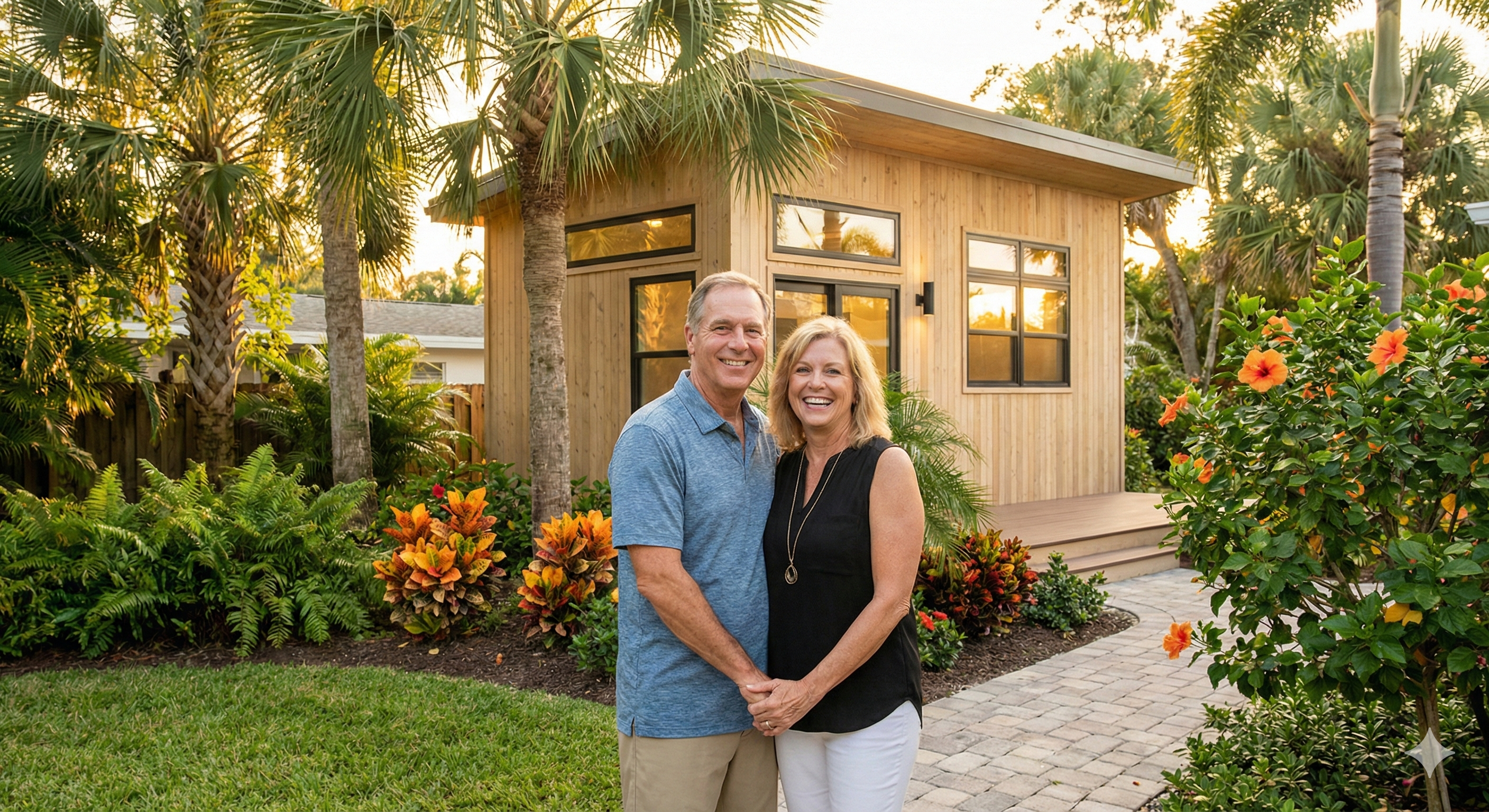
ADU Rules in Daytona Beach, Florida
We've researched Daytona Beach's ADU rules so you don't have to. Here's what matters most — the facts that determine whether your project is possible, and how much it will cost.
- ADU size is capped at 50% of the primary home's floor area — no hard square footage ceiling
- On a 1,800 sq ft home, ADU cap is 900 sq ft; on a 1,200 sq ft home, ADU cap is 600 sq ft
- Owner-occupancy required — you or an immediate family member must live on the property
- Short-term rentals under 30 days prohibited — fines up to $15,000, actively enforced
- Required setbacks: 7 ft side, 7 ft rear — maximum height 20 ft
- Planned Development (PD) zone ADUs only permitted if PD Agreement explicitly allows it
Last verified: 2026-07-19
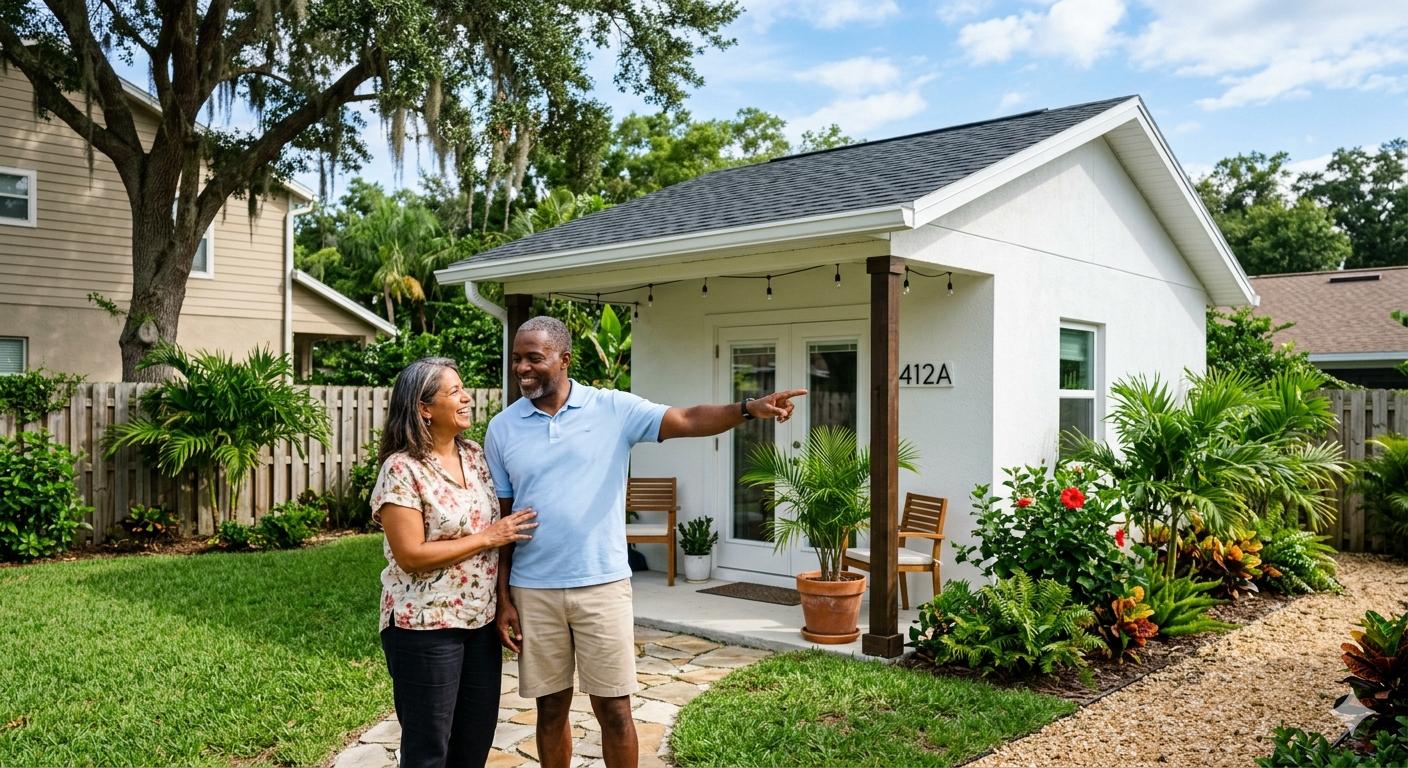
Backyard ADUs like this are being built across Daytona Beach — here's how to do it right.
What Daytona Beach's zoning may allow for an ADU
Source refreshed from newest archived Daytona Beach original DOCX extract (2026-03-06 upload). Treat this as operating guidance and verify current adopted code text with Daytona Beach Planning before quoting hard limits.
Zoning allowance
Daytona Beach allows one ADU by-right on lots where single-family detached dwellings are permitted (2021 ordinance framework; Land Development Code references include Sec. 5.3.C.32 and Sec. 11.5 definitions in source guide). Verify parcel zoning and overlays with Planning before design.
Size limits
Maximum ADU size is capped at 50% of the primary home's floor area. The source guide does not state a separate hard citywide square-foot cap.
Lot + setbacks
ADUs must comply with the underlying district's lot and setback standards for accessory structures and principal use context. Exact numeric setbacks vary by zoning district and site constraints.
Height + coverage
Height and lot-coverage limits follow underlying zoning standards and accessory-structure rules. Detached ADUs and garage conversions must remain compliant with total site coverage limits.
Parking
Off-street parking compliance is reviewed during permit review based on district/site conditions. Confirm current required stall count and any waiver criteria at zoning pre-check.
Rental / occupancy
Owner-occupancy is required in either the primary unit or the ADU. Short-term rental use under 30 days is prohibited for ADUs in residential zones under current city policy.
Permit process
Recommended path: zoning confirmation -> code-compliant plans -> building permit submission -> trade permits -> inspections -> certificate of occupancy/completion.
ADU Size Examples (50% of Primary)
| Primary Home Size | Max ADU Size |
|---|---|
| 1,200 sq ft | 600 sq ft |
| 1,800 sq ft | 900 sq ft |
| 2,400 sq ft | 1,200 sq ft |
Formula applies to floor area of primary dwelling. Verify exact measurement with Daytona Beach Planning.
Building limits and rental rules, side by side
These figures are based on the best available data for Daytona Beach and should be confirmed with the city's planning department before you commit to a design or a rental strategy — local ordinances change and vary by parcel.
Building Limits
- Max Size:See requirements above
- Setbacks:7ft side / 7ft rear
- Detached Allowed?Yes
- Max Height:20 ft
- Build Cost Est.:$65,000–$160,000 new detached; $18,000–$60,000 garage conversion
- Min Rental Period:30 days
Rental Rules
Owner-Occupancy Required: You must live in either the primary home or the ADU.
Short-Term Rentals Prohibited: Minimum 30-day stay required in Daytona Beach.
Estimated Monthly Income
$850–$1,700/month
Based on 2025–2026 Daytona Beach market data
ADUs are NOT Permitted In:
- Commercial zones
- Industrial zones
- Planned Development (PD) zones unless the PD Agreement explicitly allows ADUs
Short-Term Rental Rules in Daytona Beach
Daytona Beach prohibits short-term rentals under 30 days in residential zones — including ADUs. Despite the tourism economy, the city actively enforces this rule with significant fines.
Minimum Rental Period
30 days
STR Violation Fine
Up to $15,000 for short-term rental violations in residential zones
Owner-Occupancy Required
You or an immediate family member must live in either the primary home or the ADU at all times. This applies regardless of whether you rent the ADU.
Long-term rentals (30+ days) remain fully permitted and generate an estimated $850–$1,700/month/month based on current Daytona Beach market data.
Here's exactly what you'll pay — and how to avoid the fees that catch most homeowners off guard
Most homeowners spend 3–4 weeks piecing this together on their own. We've mapped the full Daytona Beach permit process step by step — so you know exactly what's coming, and what to prepare.
Step 1: Pre-Application Zoning Check
- Where:
- City of Daytona Beach Planning Division, 301 S. Ridgewood Ave., Daytona Beach, FL 32114
- Contact:
- (386) 671-8170 · Planning@DaytonaBeach.gov
- What to bring:
- Property address and parcel ID, preliminary site sketch, lot survey
- Timeline:
- No appointment fee — call ahead to confirm office hours
- Cost:
- No fee for initial inquiry
Step 2: Submit Permit Application
- Where:
- https://daytonabeach.gov
- Contact:
- (386) 671-8170
- What to bring:
- Architectural plans, site plan, boundary survey, energy compliance docs
- Timeline:
- Zoning verification: 1–2 weeks
- Cost:
- $3,000–$7,000
Step 3: Plan Review & Revisions
- Where:
- City of Daytona Beach Planning Division
- Contact:
- (386) 671-8170
- What to bring:
- Responses to any correction letters; revised drawings if required
- Timeline:
- Zoning verification: 1–2 weeks. Plan preparation: 4–10 weeks. Building permit review: 4–8 weeks. Total typical: 5–10 months
- Cost:
- No additional fee for standard resubmittal
Step 4: Construction & Inspections
- Where:
- Daytona Beach Building Department
- Contact:
- (386) 671-8170
- What to bring:
- Approved permit set must be on-site at all times during construction
- Timeline:
- Schedule inspections as each phase of work is completed
- Cost:
- Included in permit fee
Full Daytona Beach Permit Cost Breakdown
These are the fees you'll encounter, in the order you'll typically encounter them.
| Cost Item | Amount / Notes |
|---|---|
| Total Estimated Cost | $3,000–$7,000 |
| Building Permit Fee | Based on construction valuation — contact Planning at (386) 671-8170 |
| Plan Review | Included in permit fee |
| Impact Fees | Volusia County impact fees $3,000–$7,000+ |
| STR Violation Fine | Up to $15,000 for short-term rental violations in residential zones |
Key ADU Restrictions in Daytona Beach
These are the rules that most often catch homeowners by surprise. Read them carefully before engaging an architect.
- ADU size capped at 50% of primary home floor area — no hard square footage ceiling
- Owner-occupancy required — either primary home OR ADU must be owner-occupied at all times
- Short-term rentals under 30 days prohibited with fines up to $15,000 — actively enforced
Common Mistakes to Avoid in Daytona Beach
- Assuming tourism economy means STRs are allowed — residential STR ban fines up to $15,000
- Miscalculating the 50% floor area cap — a 900 sf home limits you to 450 sf ADU
- Ignoring PD Agreement — ADUs only allowed in Planned Development zones if PD Agreement explicitly states it
Eligible Zones in Daytona Beach
ADUs may be permitted in these zoning districts, but eligibility depends on your specific parcel and the current local ordinance. Confirm your parcel and rules with Daytona Beach Planning before relying on this — most homeowners can check their zone at the county GIS portal in a few minutes.
Daytona Beach neighborhoods where ADU permits are being filed — is your street next?
Daytona Beach ADU: The Complete Build Walkthrough
The rules above tell you whether you can build. This section covers how — the size math, the permit path, the documents, the timeline, and the rental economics — under Daytona Beach Land Development Code Section 5.3.C.32 (2021 ordinance). Florida has no statewide ADU law, so the city’s rules govern. Verify current figures with the Planning Division at (386) 671-8165 before you commit to a design.
How to Calculate Your 50% ADU Size Limit
Unlike cities with a hard square-footage cap, Daytona Beach ties your maximum ADU size directly to the size of your primary home:
- Find your primary home’s gross floor area — the conditioned living area, listed on your property record at the Volusia County Property Appraiser (vcpa.org).
- Multiply by 0.50 — that is your maximum ADU gross floor area.
- Confirm the measurement method — how garages, covered patios, and bonus rooms count toward “floor area” can change the result. Confirm with Planning Division before finalizing.
| Primary home size | 50% rule — max ADU |
|---|---|
| 1,200 sq ft | 600 sq ft |
| 1,500 sq ft | 750 sq ft |
| 1,800 sq ft | 900 sq ft |
| 2,000 sq ft | 1,000 sq ft |
| 2,500 sq ft | 1,250 sq ft |
| 3,000 sq ft | 1,500 sq ft |
| 3,500 sq ft | 1,750 sq ft |
Reference calculations only. The definition of “floor area” (gross vs. heated/cooled) can affect the figure — confirm with Daytona Beach Planning Division at (386) 671-8165.
The 8-Step Permit Process
The Daytona Beach permit path follows the standard Florida residential construction pathway:
- Verify jurisdiction and zoning district. Confirm your property is inside Daytona Beach city limits — not Daytona Beach Shores, South Daytona, Holly Hill, or unincorporated Volusia County. Check the Volusia County GIS portal (vcgov.org/gis).
- Calculate your 50% ADU size limit. Pull your primary home’s gross floor area from vcpa.org and multiply by 0.50.
- Confirm setbacks for your district. Daytona Beach ADUs follow the district’s accessory-structure setback standards, which vary by zone. Get exact figures before hiring a designer.
- Hire a Florida-licensed architect. No pre-approved ADU plans exist; you’ll need signed and sealed drawings. Budget roughly $3,000–$8,000+ for design.
- Submit the building permit application to Daytona Beach Building Services with survey, site plan, floor plans, elevations, structural drawings, energy calcs (RESCHECK), and contractor license and insurance.
- Submit trade permits. Electrical, plumbing, and mechanical work require separate licensed-subcontractor permits before rough work begins.
- Record a Notice of Commencement (NOC) with the Volusia County Clerk before construction, and post a certified copy on-site. This is a Florida legal requirement.
- Build, pass inspections, and get your Certificate of Occupancy. Do not occupy the ADU before the CO is issued. Remember: the owner must occupy either the primary home or the ADU.
Required Documents Checklist
Everything you’ll need to submit your Daytona Beach ADU building permit:
- Completed building permit application (Daytona Beach Building Services)
- Current property survey, signed and sealed by a Florida-licensed land surveyor
- Site plan: lot boundaries, existing structures, proposed ADU footprint, setback distances to all property lines, parking, and driveway access
- Floor plans signed and sealed by a Florida-licensed architect or engineer, showing the ADU is ≤50% of the primary home’s floor area
- Building elevations for all four sides, showing exterior materials
- Foundation plan and structural details compliant with the Florida Building Code
- Electrical, plumbing, and mechanical plans from licensed Florida subcontractors
- Florida Building Code energy compliance calculations (RESCHECK)
- Contractor’s Florida license number and certificate of insurance
- Notice of Commencement (recorded with the Volusia County Clerk before construction)
Permit Timeline
Plan for the full arc from zoning check to Certificate of Occupancy. The Private Provider route can meaningfully compress plan review:
| Phase | Duration |
|---|---|
| Jurisdiction + zoning verification | 1–2 weeks |
| Survey and property records | 1–2 weeks |
| Design and plan preparation (50% compliance) | 4–10 weeks |
| Standard plan review | 4–8 weeks |
| Expedited review via Private Provider | 1–3 weeks |
| Construction | 3–5 months |
| Final inspection and CO | 1–2 weeks |
| Total — standard path | 7–12 months |
| Total — expedited (Private Provider) | 5–9 months |
Renting Your ADU: The Volusia County Long-Term Market
Daytona Beach is a mixed economy — tourism, medical (AdventHealth Daytona Beach, Halifax Health), logistics (the I-4 corridor), motorsport/NASCAR, and higher education (Embry-Riddle Aeronautical University, Bethune-Cookman University). Long-term demand is steady year-round. Because STR under 30 days is prohibited for ADUs here, build your financial model entirely on long-term rent.
| Studio ADU estimate | $900–$1,100/month (2025–2026 market) |
| 1-bedroom ADU estimate | $1,050–$1,350/month |
| Key demand drivers | Healthcare, Embry-Riddle, Bethune-Cookman, NASCAR/motorsport, I-4 logistics |
| Vacancy risk | Moderate — tourism seasonality offset by healthcare/education year-round demand |
| Best tenant profile | Healthcare workers, university staff/students, motorsport employees, long-term retirees (12+ month leases) |
Long-Term Rental Logistics
- Owner occupancy: you must live in either the primary home or the ADU — confirm this is workable before committing.
- Unit address: establish a separate mailing address (e.g., 123 Main St, Unit B) for lease and utility purposes.
- Utility metering: sub-metered or separate accounts are preferred for clean billing — contact Daytona Beach Utilities.
- Florida landlord-tenant law: Florida Statute Chapter 83 governs all residential tenancies — security deposits held properly, 12-hour entry notice, 15-day notice to end a month-to-month tenancy, and no self-help evictions.
Common Pitfalls & How to Avoid Them
- Building a model on STR income. Daytona Beach prohibits STR under 30 days for ADUs in residential zones (LDC Sec. 5.3.C.32). If Airbnb income is central to your plan, this is a deal-breaker — these ADUs only work as long-term rentals.
- Miscalculating the 50% floor-area limit. Using the wrong measurement (heated vs. gross, garage in or out) can produce a design that fails plan review. Confirm the methodology with Planning Division.
- Ignoring owner occupancy. You must live in the primary home or the ADU. Renting both units and moving elsewhere is not permitted.
- Confusing Daytona Beach with neighboring jurisdictions. Daytona Beach Shores, South Daytona, Holly Hill, and unincorporated Volusia County each have different rules. Confirm your boundary at vcgov.org/gis.
- Skipping the pre-application zoning call. Setback standards vary by district and aren’t easily found online. A short call to (386) 671-8165 gets exact requirements before you pay a designer.
- Not recording the Notice of Commencement. Florida law requires the NOC be recorded and posted before construction; skipping it creates lien-law complications that can delay your CO.
- Assuming city permits override your HOA. They don’t. Review your CC&Rs — some Daytona Beach HOAs restrict accessory units or rental use.
Key Contacts & Resources
- Daytona Beach Planning Division — (386) 671-8165, daytonabeach.com/planning
- Daytona Beach Building Services — daytonabeach.com/departments/building_services
- LDC Sec. 5.3.C.32 (Municode) — library.municode.com/fl/daytona_beach
- Volusia County GIS portal — vcgov.org/gis
- Volusia County Property Appraiser — vcpa.org
- Volusia County Clerk (NOC recording) — volusia.org/clerk
- Florida Building Code / Private Providers — floridabuilding.org
- Florida Power & Light — (800) 226-3545, fpl.com
Daytona Beach ADU — Frequently Asked Questions
These are the questions we hear most often from Daytona Beach homeowners. If yours isn't here, our ADU Zoning Experts can answer it directly.
Can I build an ADU in Daytona Beach?
Yes. Daytona Beach allows one ADU by right on lots where single-family detached dwellings are permitted, including SFR-1 through SFR-5 and RC-1/RC-2 districts. PD-zoned properties require confirmation from the specific PD Agreement.
What is the maximum ADU size in Daytona Beach?
There is no hard square footage ceiling — your ADU is capped at 50% of the primary dwelling's floor area. A 1,800 sq ft home supports up to a 900 sq ft ADU. A 1,200 sq ft home supports up to 600 sq ft. Measure your primary home's floor area before designing.
Do I need to live on the property to build or rent an ADU in Daytona Beach?
Yes. Daytona Beach requires owner-occupancy — you or an immediate family member must live in either the primary home or the ADU at all times.
Can I use my Daytona Beach ADU as an Airbnb?
No. Daytona Beach prohibits short-term rentals under 30 days in residential zones despite the city's tourism economy. Fines reach $15,000 for violations and enforcement is active. Your ADU must be rented for a minimum of 30 days per stay.
How long does the Daytona Beach ADU permit process take?
5–10 months total: 1–2 weeks for zoning verification, 4–10 weeks for plan preparation with a Florida-licensed designer, 4–8 weeks for building permit review, plus inspections and Certificate of Occupancy. Call Daytona Beach Planning at (386) 671-8170 or email Planning@DaytonaBeach.gov for pre-application guidance.
Daytona Beach Planning Department
We recommend calling City of Daytona Beach Planning Division at (386) 671-8170 before submitting anything — a 10-minute conversation can save weeks of back-and-forth on your permit application.
City of Daytona Beach Planning Division
Nearby Cities — ADU Rules
Get your free Daytona Beach ADU Guide
Your personal zoning report + complete Daytona Beach ADU requirements — delivered free to your email in 60 seconds.
No spam. Unsubscribe anytime. Used by 10,000+ Florida homeowners.
More Volusia County ADU Guides
Looking for ADU Builders in Daytona Beach?
How to choose a builder, what they won't tell you, and real cost breakdowns.
Serving homeowners in 32114, 32117, 32118, 32119, 32124 and surrounding Daytona Beach zip codes.
This page provides general information based on current ordinances and publicly available data as of March 2026. Zoning rules change — verify all requirements with your local planning department before making financial commitments.