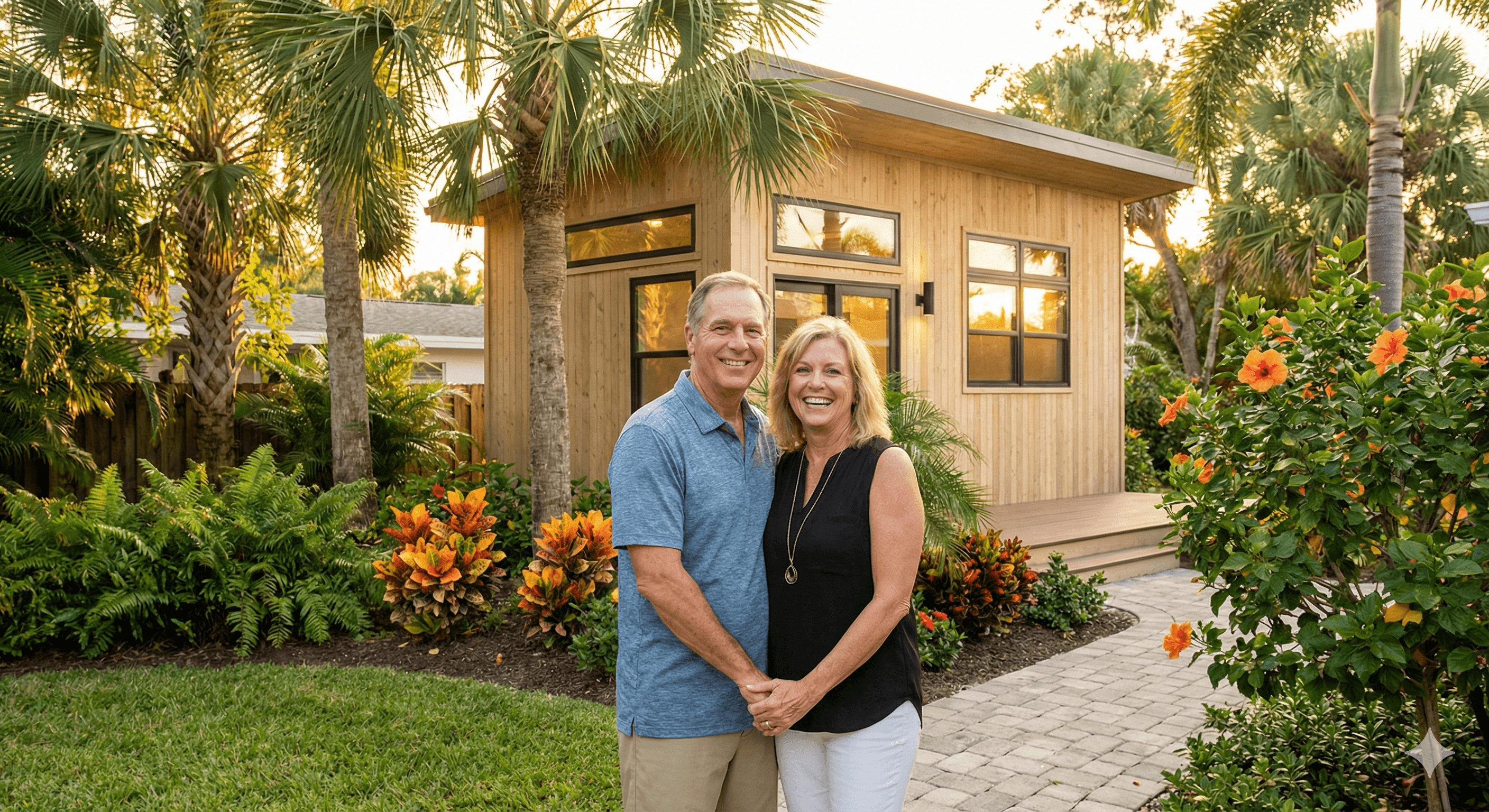
What Florida Law Actually Says About ADUs
There is no universal statewide right to build an ADU in Florida. Florida Statute §163.31771 allows local governments to adopt ordinances permitting ADUs — it does not require them to, and it does not preempt local control. Whether you can build one, and at what size, is decided by the city or county ordinance that governs your parcel.
- Authorizes local governments to permit ADUs (§163.31771)
- Leaves the decision to allow ADUs to each city and county
- Does not create a statewide right to build on every lot
- Whether ADUs are allowed, and in which zoning districts
- Maximum size, setbacks, height, parking and design standards
- Any owner-occupancy requirement
- Permit process and timeline
Florida Statute §163.31771 also states that an application for a building permit to construct an ADU must include an affidavit attesting that the unit will be rented at an affordable rate to an eligible extremely-low-, very-low-, low- or moderate-income household. Confirm how the requirement applies to your project with the relevant local planning and building departments.
Source: Florida Statutes §163.31771. HOA deed restrictions are separate from zoning and are not overridden by local ADU ordinances.
What SB 48 Proposed, and Why It Matters
SB 48 (2026) was a proposal, not law. As introduced, it would have expanded ADU rights statewide — for example limiting how far local governments could restrict ADUs and addressing owner-occupancy requirements — and set a deadline for local ordinances. The bill did not pass, so none of its provisions took effect.
An earlier bill, SB 184 (2025), also would have expanded ADU rights statewide and likewise did not become law. The takeaway for homeowners is the same: because neither bill passed, ADU eligibility continues to be governed by local ordinances under §163.31771.
SB 184 vs SB 48: What Each Bill Proposed
Neither bill became law, so none of these provisions are in effect. Florida Statute §163.31771 lets local governments allow ADUs, and your city or county ordinance is what determines what you can actually build.
| Proposed provision | SB 184 (2025) DID NOT PASS | SB 48 (2026) DID NOT PASS |
|---|---|---|
| Would have required ADUs in single-family zones | Yes | Yes |
| Would have barred cities from banning ADUs outright | Yes | Yes |
| Would have set a statewide minimum ADU size floor | No | Yes |
| Would have limited how far cities could cap ADU size | No | Yes |
| Would have restricted owner-occupancy requirements | No | Yes |
| Would have preserved HOA restrictions | Yes | Yes |
| Would have restricted short-term rentals (<30 days) in ADUs | Yes | Yes |
| Proposed deadline for local ordinances | July 1, 2025 | Dec 1, 2026 |
| Outcome | ✗ Did not become law | ✗ Did not become law |
Sources: FL SB 184 (2025) · FL SB 48 (2026)
The HOA Exception: Why Your HOA Can Still Block Your ADU
This is one of the most misunderstood parts of Florida ADU rules. Even where a city or county ordinance permits an ADU, private deed restrictions and HOA covenants are a separate matter. Local zoning permission does not override a recorded HOA restriction.
- If your city allows ADUs and your lot qualifies — you can build one, regardless of what the city used to say
- If your HOA documents prohibit accessory structures or secondary dwellings — state law does not override that. Your HOA still wins.
- Check your HOA CC&Rs before doing anything else. Search for terms like "accessory structure," "secondary dwelling," "detached building," or "guest house."
How Major Florida Cities Regulate ADUs
Because there is no statewide ADU law, each city sets its own rules. The examples below are illustrative and can change — confirm current requirements with the applicable planning department before relying on them.
| City | Owner-Occ Required? | Max ADU Size | Where Allowed |
|---|---|---|---|
| Orlando | Not required | 500–1,000 sq ft | Most SF districts |
| Tampa | Not required | 800–1,200 sq ft | 8 designated overlays only |
| Jacksonville | Required (owner in one unit) | 25% of primary or 750 sq ft | Most SF districts |
| Miami | Not required | 400–1,200 sq ft (varies by transect) | T3-O, T4, T5, T6 only |
| St. Petersburg | Not required | 800 sq ft | Most SF districts |
| Gainesville | Required | 800 sq ft | Most SF districts |
Rules current as of June 2026. City ordinances change — verify before permitting. Check your specific address →
What Would Have Changed If SB 48 Had Passed
SB 48 was a proposal that never took effect. Understanding what it would have done matters because similar legislation could return in a future session. As introduced, the bill would have:
Could Similar Legislation Return?
Possibly. Statewide ADU legislation has been introduced in Florida in recent sessions but has not been enacted. Whether a similar bill returns, and in what form, is up to the Legislature.
Until any such bill becomes law, nothing about statewide ADU rights has changed: eligibility is governed by local ordinances under Florida Statute §163.31771. If a future bill is enacted, we will update this page.
- • Whether ADU provisions are introduced as a standalone bill or bundled with a broader housing package
- • Whether any statewide baseline for ADU size or owner-occupancy is proposed again
- • Whether individual cities update their ordinances independently of any state action
Local Rules Decide — Your Parcel's Zoning Is What Counts
Because there is no statewide ADU right, your eligibility depends on your local ordinance, your parcel's zoning district, your lot size, your setbacks, and whether your HOA permits it. Two houses on the same street can have different answers. The only way to know is to check your address.